Cash businesses in New York City deal with a problem that never fully goes away. Money comes in through the day, staff handles it at different points, and at some point between the register and the bank, that cash is at risk. A depository safe in NYC solves a very specific part of that problem, but only if you choose the right one for how your business actually operates.
What Makes a Depository Safe Different From Other Business Safes
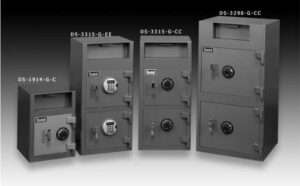
A depository safe has a slot on the outside that allows cash, envelopes, or small items to be dropped in without opening the main door. This means your staff can deposit at the end of each shift without ever accessing the full interior. It removes the need to give multiple employees the combination or key to the main compartment.
This design is what makes depository safes the go-to choice for retail stores, restaurants, pharmacies, hotels, and any business where cash changes hands at different times of day.
Step One: Know How Much You Need to Store
Before looking at models, calculate your average daily deposit volume. A small retail shop might handle a few hundred dollars in notes per shift. A restaurant over a weekend might process several thousand. The size of the interior compartment needs to match your volume, or you will find yourself opening the safe more often than intended, which reduces the point of having a drop slot.
Depository safes come in a range of capacities. Compact front-load models work for low-volume businesses. Larger dual-compartment safes let you separate cash by shift or by employee, which supports accountability.
Step Two: Choose the Right Drop Slot Type
Front-Load Slot
The most common type. The deposit slot is on the front face of the safe. Easy access, works well for envelopes and bundled notes. You will find this in most retail environments.
Top-Load Hopper
The opening is on the top of the safe. Items drop straight down into the interior. This type works well when the safe is positioned below a counter, and staff drop items from above without bending down.
Rotary Hopper
A rotating chamber allows deposits without giving direct access to the interior. This is a higher-security option that prevents fishing attacks, where someone uses a tool through the slot to retrieve cash. For businesses in high-traffic or higher-risk areas of NYC, a rotary hopper is worth the additional cost.
Step Three: Look at the Security Rating
Not all depository safes carry the same level of burglary resistance. In the United States, the Underwriters Laboratories rates safes based on the time and tools required to break in. Look for these ratings when selecting a depository safe in NYC:
- B-Rate: Entry level, sheet metal construction, basic locking mechanism
- C-Rate: Thicker steel, more resistance to drilling and prying
- UL RSC (Residential Security Container): Tested to withstand five minutes of attack with standard tools
- UL TL-15 or TL-30: Commercial grade, withstands tool attacks for 15 or 30 minutes, respectively
For most NYC businesses, a UL RSC or C-Rate safe covers the daily risk. If you are storing higher amounts of cash or operating in an area with a history of commercial break-ins, a TL-rated safe gives stronger protection.
According to the FBI Uniform Crime Report, commercial burglaries remain one of the most common property crimes. A safe that takes 30 minutes or more to breach is a meaningful deterrent in most cases.
Step Four: Decide on the Locking Mechanism
Depository safes come with different lock types, and each one has trade-offs.
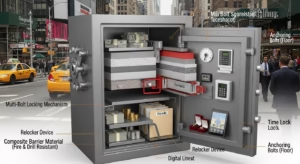
- Electronic keypad: Fast, no physical key to lose, easy to change codes. Batteries need to be replaced periodically
- Mechanical combination: No battery dependency, but slower to operate, and combination changes require a locksmith
- Dual lock: Requires both a key and a code to open. Better for businesses where two-person access is a policy requirement
- Biometric: Fingerprint access is fast and audit-friendly, but higher cost and more maintenance
For most commercial applications, an electronic keypad with a backup key override covers the daily need without complications.
Step Five: Think About Placement and Installation
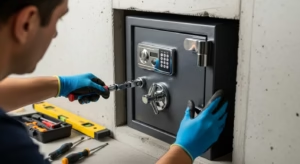
A depository safe that is not anchored is a portable safe. Any quality depository safe in NYC should be bolted to the floor or wall. Most models come with pre-drilled anchor holes. Placement matters too. The safe should be in a location that is accessible to staff but not visible to customers or visitors.
If you are also evaluating other security upgrades alongside this purchase, safe installation services can handle both the anchoring and the placement assessment so the unit is set up to work correctly from day one.
What Businesses in NYC Need to Watch Out For
- Buying a safe based on price without checking the UL rating
- Choosing a slot type that does not match how staff actually make deposits
- Skipping the anchor installation because the safe feels heavy enough on its own
- Setting one combination that all staff use, with no audit trail
If access control and accountability matter to your operation, pairing a depository safe with a safe combination change policy for each staff rotation adds a layer of control that many businesses overlook.
The Wrong Safe Costs You More Than the Right One
A cheap depository safe that gets pried open in under five minutes is not an asset. It is a false sense of security that costs you both the cash inside and the replacement unit. Choosing a depository safe in NYC that matches your volume, your risk level, and your access requirements is a business decision with a measurable return.
City Safe & Vault carries a range of depository safes for commercial use and handles installation across New York City. Contact us today, and we will help you identify the right model for your business before you spend a dollar in the wrong direction.